Choosing a colored contact lens manufacturer is not just a price comparison. The decision affects product consistency, eye comfort, and the reliability of every shipment. Ophthalmologist and contact lens safety expert Dr. Thomas Steinemann has emphasized: “Contact lenses are medical devices, not ordinary fashion accessories.” That principle matters for colored lenses, too. A striking shade means little if quality controls are unclear.
This guide presents seven practical checks for evaluating a potential manufacturing partner. It considers documented quality systems, material and color consistency, production capacity, customization, packaging, communication, and after-sales support. Ask for current product specifications and sample lenses. Compare the printed shade with the lens in natural light. Check whether the manufacturer explains inspection procedures and can trace production batches. Small details count. A slow reply to a technical question may reveal more than a glossy brochure.
Price deserves attention, but it should not lead the decision. A low quote can hide limits in customization, testing, or delivery planning. Still, a high price is no guarantee of dependable work. Even careful buyers can miss something. Review your own requirements before requesting samples, and record what each supplier promises. The aim is not to find a flawless colored contact lens manufacturer on paper. It is to identify a partner whose evidence, communication, and production practices stand up to practical scrutiny.
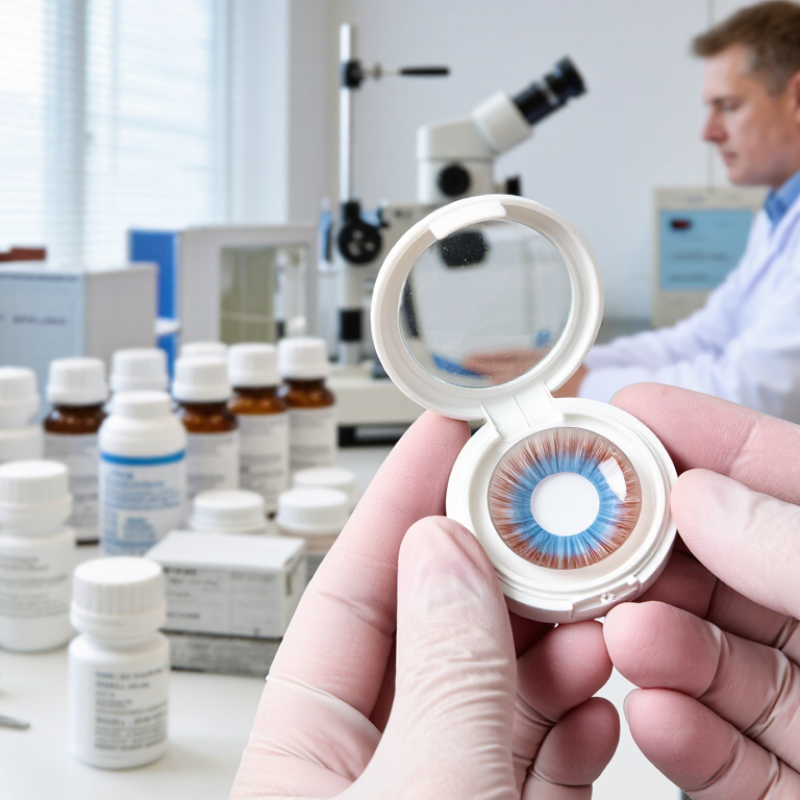
When choosing a colored contact lens manufacturer, verify how its products are regulated in the United States. Contact lenses are FDA-regulated medical devices, and many fall under Class II controls. Decorative lenses are not exempt just because they have no vision-correction power. They still require a valid prescription and professional fitting. Cosmetic does not mean risk-free.
Ask for the specific product’s FDA clearance or other applicable regulatory documentation. Check that the package identifies the manufacturer, lens material, measurements, and replacement schedule. FDA establishment registration or device listing alone does not mean the FDA has approved a product or endorsed its safety. That distinction is easy to miss. A reliable supplier should explain it clearly and provide traceability details, such as lot numbers, so a lens can be identified if a concern arises.
In the U.S., purchase lenses only with a prescription from a licensed eye-care professional, including decorative styles. Be cautious if a seller offers lenses without requesting one, or cannot explain its documentation. Even careful checks cannot confirm that a lens fits your eyes; an eye-care professional must assess fit and eye health.
A colored lens manufacturer should provide more than a certificate image. Ask for the current ISO 13485:2016 certificate and check its scope, manufacturing site, and expiry date. The quality system should cover relevant activities, not just an unrelated office. Request examples of batch records, equipment calibration logs, and procedures for handling defects. These documents show how quality controls work on an ordinary production day.
ISO 18369 is a series of standards for contact lenses, including terminology, measurement methods, and specifications. Ask which parts and editions the manufacturer uses, and how it verifies lens dimensions and optical power. For colored lenses, ask how color consistency and surface defects are inspected across batches. Request test reports linked to the product and production lot, rather than a generic sample. Small details matter. A neat certificate cannot prove every lens was checked correctly. Paperwork can look tidy while a production record is incomplete; that possibility deserves a closer look. Compare answers with the actual documents, and ask for clarification when figures or product names do not match.
A colored lens can look vivid in a product photo and still be a poor match on the eye. When comparing manufacturers, ask for Dk/t data, not just a material’s Dk value. Dk/t describes oxygen transmissibility through a finished lens, and thickness can change it. Request figures for the exact lens design and power you plan to source. Numbers need context. Check that suppliers use comparable test conditions, and ask for supporting technical documents rather than relying on a headline claim.
Base curve and diameter matter just as much. A base curve that is too steep or too flat may affect how a lens moves and centers; diameter influences how much of the cornea it covers. These measurements are not interchangeable across designs. Ask for the full specification sheet, available size ranges, and fitting guidance, then have an eye-care professional assess fit on the intended wearer. A sample that looks centered in a package proves very little. That part is easy to overlook.
I would not rank a manufacturer by one attractive number. Compare the same powers, lens thicknesses, and design types wherever possible. If data are missing, inconsistent, or difficult to explain, pause and ask why. I used to treat a neat table as reassuring; it is not enough. Ask how measurements are verified and how changes to color layers or lens geometry are documented. A clear answer is more useful than polished language.
| Tip | Comparison factor | What to check | How to assess it |
|---|---|---|---|
| 1 | Dk/t oxygen transmissibility | Request the Dk/t value for the finished lens, with its unit, lens power, measurement method, and test conditions. Dk/t is affected by lens thickness as well as material oxygen permeability. | Compare like with like: values measured at different powers, thicknesses, or under different methods may not be directly comparable. Do not treat a material’s Dk value as the finished lens’s Dk/t. |
| 2 | Base curve (BC) | Check the available base-curve specifications and whether the manufacturer provides technical documentation for the lens design. | Base curve is one part of lens fit, not a stand-alone guarantee of comfort or safety. The appropriate fit should be assessed by an eye-care professional on the wearer’s eye. |
| 3 | Diameter (DIA) | Confirm the lens diameter and the exact product version to which the specification applies. | Diameter, base curve, and overall lens design work together. A listed diameter alone cannot establish that a lens will fit a particular wearer. |
| 4 | Material and thickness profile | Ask for the material description and thickness information, including center thickness at the stated lens power where available. | Oxygen transmissibility depends on both material properties and lens thickness. Colored designs may have different construction features, so assess the complete lens rather than material claims alone. |
| 5 | Color design and clear optical zone | Request a diagram or technical description showing the colored area and the clear zone over the pupil. | The appearance and usable clear zone can vary by design and by wearer. Review the design under appropriate lighting and check that vision is not obstructed in different lighting conditions. |
| 6 | Quality, safety, and traceability | Verify applicable regulatory documentation for the intended market, product labeling, lot identification, and a process for handling complaints or recalls. | Requirements differ by country or region. Confirm the relevant authorization or conformity documentation directly with the responsible regulatory authority or qualified professional. |
| 7 | Replacement, care, and wearer support | Check the stated replacement schedule, care instructions, packaging information, and availability of product-specific support materials. | Colored contact lenses require proper fitting, hygiene, and care just like other contact lenses. Follow the prescribed wearing schedule and seek professional advice if irritation, pain, redness, or blurred vision occurs. |
Specifications should be confirmed against current product documentation. Contact lenses, including cosmetic colored lenses, should be fitted and used with guidance from an eye-care professional.
When evaluating a colored contact lens manufacturer, ask for the biological evaluation behind its ISO 10993 claims. ISO 10993 is a framework, not a single safety certificate. Review which tests were performed, which materials were tested, and whether the samples represent the finished lens. Details matter. The report should identify test methods, results, and any limits on interpretation. Check whether testing reflects the lens’s intended wear period and processing, including sterilization where applicable. A document with a familiar standard number can still leave important questions unanswered.
Ask for evidence that pigments remain stable and do not migrate from the lens under relevant test conditions. Look for data on color consistency, pigment containment, and surface integrity after exposure to moisture and handling. Microscopic images can help show whether the colored layer is covered or exposed, but images alone are not proof of performance. Request test dates, sample identification, and links to production batches. A useful review can still miss variation between batches, so ask how routine quality checks detect it. The evidence may be imperfect; clear methods and candid limits are more reassuring than broad promises.
A useful review point for ISO 10993 evidence is the commonly applied ISO 10993-5 cytotoxicity interpretation: cell viability below 70% of the untreated control indicates potential cytotoxicity.
What to ask: Request the complete test report, methods, and sample details—not only a pass statement. For colored lenses, also ask how pigment stability, migration or leachables, and chemical characterization were evaluated. These assessments are risk-based; there is no single universal pigment-migration pass value.
Tip 1: Ask how each lens lot is traced from incoming materials to finished cartons. A lot code should connect production dates, inspection records, and shipment details.
Tip 2: Request a sample traceability record with sensitive details removed. Can staff retrieve it quickly? Small gaps matter.
Tip 3: Review packaging validation, not just the package design. Ask whether seal integrity, label readability, and expiry printing were checked under defined conditions.
Tip 4: Ask how transport or storage testing reflects real handling. A sealed blister may look fine, yet a weak seal can be hard to spot. A tidy spreadsheet is not proof by itself.
Tip 5: Request documented defect rates by defect type and production period. Clarify the denominator, such as lenses inspected or cartons produced, and how defects are classified.
Tip 6: Check whether results include trends, complaints, and corrective actions.
Tip 7: Ask how repeat issues are verified as resolved. Some records may be incomplete; note that plainly and request the missing evidence before comparing suppliers. A low rate needs context. Compare reporting methods, inspection sampling, and follow-up practices, not just the headline percentage.
Check the certificate’s scope, production site, and expiry date. Confirm it covers relevant manufacturing activities. A certificate image is not enough.
Request batch records, equipment calibration logs, and defect-handling procedures. Check whether the documents match the product and production site. Details matter.
It covers contact-lens terminology, measurement methods, and specifications. Ask which parts and editions the manufacturer follows, and how lens dimensions and optical power are checked.
Ask for Dk/t data for the exact lens design and power. Request supporting documents and comparable test conditions. One number lacks context.
They affect lens movement, centering, and corneal coverage. Request the full specification sheet and fitting guidance. Have an eye-care professional assess fit.
It should identify test methods, materials, results, and interpretation limits. Check whether samples represent finished lenses and the intended wear period. Read the details.
Ask for evidence about color consistency, pigment containment, and surface integrity after relevant testing. Microscopic images may help, but they are not proof alone.
Check test dates, sample identification, and links to specific product batches. Ask how routine checks detect batch variation. I would still ask questions.
Choosing a colored contact lens manufacturer requires evaluating both regulatory readiness and product quality. Confirm that the manufacturer can document the appropriate FDA Class II status for its lenses and explain how its products support applicable U.S. prescription requirements. Review its ISO 13485:2016 quality-management certification and evidence that lens specifications align with ISO 18369. These records can help show that production and quality controls are consistently managed.
Next, compare technical data for oxygen transmissibility (Dk/t), base curve, and diameter to assess whether lens designs meet stated performance and fit specifications. Ask for ISO 10993 biocompatibility evidence and testing related to color pigments, including their safety in the finished lens. Also examine lot traceability, packaging validation, and documented defect rates. A manufacturer that provides clear, current records across these areas makes it easier to assess product consistency, identify potential risks, and make a well-informed sourcing decision.